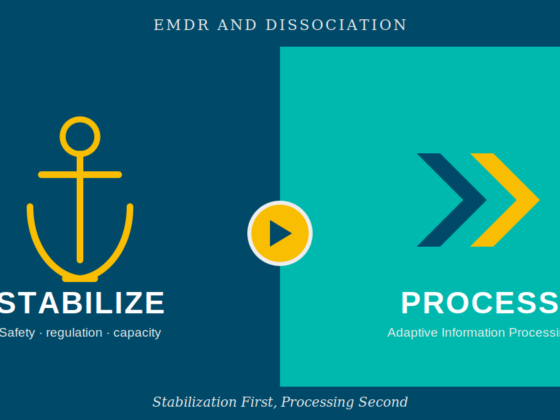



If you’ve completed your EMDR Basic Training and are building confidence with individual clients, you may be experiencing a familiar feeling: how to determine appropriate targets for complex trauma presentations, ongoing traumatic stress and developmental trauma? This is where EMDR Advanced Training comes in to fill the gap in knowledge.
Also known as the EMDR GAP Training, these specialized programs bridge the gap between basic competency and advanced mastery, offering clinicians adapted protocols for complex trauma presentations and specialized populations.
This article will clarify what the GAP Training is, who it’s designed for, and how it fits into your professional development pathway as an EMDR therapist.
What Is EMDR GAP Training?
EMDR GAP Training teaches clinicians how to apply EMDR therapy in group settings and with specific trauma presentations. ‘GAP’ is an acronym for Group (IGTP), ASSYST, and PRECI – these are the three EMDR advanced protocols and procedures you learn during the GAP training.
This training was developed in response to a clear clinical need: while EMDR Basic Training provides the foundation for individual trauma work, many diverse practice settings require therapists to work with groups, manage acute crisis situations, or address collective trauma. Traditional EMDR protocols aren’t always appropriate or efficient in these contexts.
The GAP frameworks include:
- EMDR Integrative Group Treatment Protocol (EMDR-IGTP) for ongoing trauma stress (and recent events)
- ASSYST (Acute Stress Syndrome Stabilization) Treatment Interventions
- EMDR Protocol for Recent Critical Incidents (EMDR-PRECI) and ongoing traumatic stress
Who Is GAP Training Designed For?
EMDR Advanced Training programs are specifically designed for clinicians who have already completed EMDRIA-approved Basic Training. This prerequisite exists for good reason: the protocols taught in GAP trainings assume familiarity with the eight phases of EMDR, the Adaptive Information Processing model, and the standard EMDR protocol.
GAP Training is particularly valuable for clinicians who:
- Work in community mental health settings where group therapy is a primary modality
- Serve crisis response teams or disaster mental health programs
- Provide services in schools, residential treatment facilities, or inpatient settings
- Work with first responders, military populations, or other groups with shared trauma exposure
- Want to expand their clinical repertoire and build confidence in handling complex cases with developmental trauma and many targets
- Need efficient trauma interventions for populations facing ongoing adversity
Importantly, you don’t need to be pursuing EMDR certification to benefit from GAP Training. These protocols are valuable clinical tools that enhance your practice whether or not certification is in your plans. However, it does provide 14 EMDRIA CEUs that you can apply toward certification.
How the GAP Training Fits Into the EMDR Training Pathway
Understanding where the GAP Training sits in the larger EMDR training landscape helps clinicians make informed decisions about their professional development. Here’s how the training pathway typically unfolds:
EMDR Basic Training
This is the required foundation—a minimum of 50 hours covering the eight phases of EMDR therapy, the Adaptive Information Processing model, and standard protocols for working with individual clients.
Post-Basic Clinical Practice
After Basic Training, clinicians begin applying EMDR with clients while building confidence and experience. This is where many therapists encounter clinical situations that call for more specialized training.
EMDR Advanced Training (GAP Training)
Specialized protocol training that deepens clinical skills and expands treatment capacity. These programs can be taken in any order based on clinical need and are not prerequisites for one another.
EMDR Certification (Optional)
A comprehensive credentialing process requiring 50 client sessions, 20 hours of consultation, advanced CEU courses, and documented competency. While GAP Training hours may count toward your EMDR Advanced Training CEUs, certification is a distinct and more extensive process.
The EMDR GAP training provides specialized clinical tools that enhance your ability to serve diverse populations and complex trauma presentations—skills that can complement both general EMDR practice and certification preparation.
For a detailed overview of available GAP training program and schedule, clinicians can explore structured offerings that fit their specific clinical contexts.
What Clinicians Gain from EMDR Advanced Training
The value of various EMDR professional training programs extend well beyond adding protocols to your clinical toolkit. Participants consistently report several key benefits:
Expanded Treatment Capacity
Group protocols allow you to serve more clients efficiently without sacrificing clinical effectiveness. In settings where individual therapy slots are limited—schools, community clinics, disaster response—this capacity matters.
Clinical Confidence in Complex Scenarios
Working with acute trauma, collective trauma, or crisis situations requires specific skills taught in the stepped-care approach model inherent to the EMDR GAP Training. The specialized protocols learned in the GAP Training provide clear, evidence-based frameworks for managing complexity.
Professional Differentiation
As EMDR becomes more widely adopted, specialized training helps you stand out. Being able to offer group EMDR services or crisis response expertise makes you a more valuable resource to employers, referral sources, and communities.
Deeper Understanding of EMDR Principles
Learning how EMDR is adapted for different contexts deepens your conceptual understanding of the AIP model and EMDR mechanisms. Many clinicians report that the GAP Training strengthens their overall EMDR practice.
Connection to Specialized Communities
These trainings often connect you with clinicians working in varied contexts—disaster response, first responder care, refugee services, etc. These professional relationships can be invaluable for consultation and support.
IGTP vs. GTEP: Understanding the Difference
First, there’s G-TEP: The Group Traumatic Episode Protocol
- G-TEP was designed as an early intervention protocol for groups affected by a shared traumatic event.
- It uses a worksheet-based, visual format where each participant follows along at their own pace—privately focusing on their experience without having to share verbally.
- G-TEP is often used in humanitarian and local settings.
- It’s structured, contained, and helps reduce distress tied to recent trauma exposure.
Our go-to protocol is the EMDR-Integrative Group Treatment Protocol—or EMDR-IGTP
This protocol is part of our EMDR GAP Training. It was the first EMDR group protocol to be created. It is part of a stepped-care approach to mental health, along with the other interventions taught in the EMDR GAP Training. These protocols are the most researched in the early intervention and ongoing traumatic stress fields with over 100 peer-reviewed articles.
The EMDR-IGTP is especially helpful when working with clients experiencing ongoing traumatic stress, such as conflict-affected populations, marginalized groups, or communities with chronic exposure to violence or instability.
It is highly effective in treating clients in the aftermath of climate or human-made disasters, wars, and large scale adverse events.
Clients navigating highly contentious divorces, family loss, medical diagnoses, sexual abuse, and domestic violence also benefit from the EMDR-IGTP
Like G-TEP, EMDR-IGTP is also non-verbal and uses visual elements, including something called the Butterfly Hug (created by Lucy Artigas) for bilateral stimulation.
What makes EMDR-IGTP unique is that it’s designed to be delivered across multiple sessions in an intensive format, giving clients the space to build trust in the process, strengthen their resilience, and gradually move into deeper levels of processing at a pace that feels safe.
Common Misconceptions About GAP Training
As the GAP Training has grown in popularity, several misconceptions have emerged. Clarifying these can help clinicians make informed training decisions.
Misconception 1: EMDR GAP Training Is Required for EMDR Certification
Reality: EMDR certification requires EMDR Basic Training, consultation hours, and documented client sessions—not the EMDR GAP Training. While the CEU hours gained from the EMDR GAP training may count toward certification requirements, EMDR GAP Training itself is not a prerequisite.
Misconception 2: You Need to Be Certified to Take GAP Training
Reality: The EMDR GAP Training is open to any clinician who has completed EMDRIA-approved EMDR Basic Training. Certification is not required, and many clinicians benefit from these protocols without ever pursuing certification.
Misconception 3: Group Protocols Are ‘Watered Down’ EMDR
Reality: EMDR Group protocols are evidence-based adaptations designed for specific contexts, not simplified versions. Currently, there are over 50 research articles published on the effectiveness of the EMDR-IGTP. They require solid clinical judgment, trauma competence, and thorough training. In appropriate contexts, they can be as effective as individual EMDR—and sometimes more practical.
Misconception 4: EMDR GAP Training Is Only for Crisis Response
Reality: While crisis applications are one important use case, EMDR GAP protocols are regularly used in ongoing clinical practice—schools, residential treatment, community mental health, veteran services, and more. These are not emergency-only tools.
Clinical Scenarios Where EMDR GAP Training Is Especially Useful
Understanding when EMDR GAP protocols shine helps clinicians assess whether this training matches their professional needs. Consider these scenarios:
School-Based Practice
School counselors and social workers face unique constraints: high caseloads, limited individual therapy time, and the need to serve students efficiently. EMDR Group Protocols allow you to address trauma affecting multiple students simultaneously—whether from a community tragedy, school lockdown, or loss of a classmate—while working within the school day structure.
Community Mental Health Centers
Many community clinics operate primarily through group therapy due to funding models and demand. EMDR GAP Protocols enable you to offer evidence-based trauma treatment in the group format your setting requires, making EMDR accessible to populations who might otherwise wait months for individual slots.
First Responder Services
Firefighters, law enforcement, and EMS personnel rarely seek individual therapy due to stigma and time constraints. EMDR GAP Protocols a framework for processing cumulative occupational trauma in individual and peer group settings.
Disaster Mental Health Response
When natural disasters, mass violence events, or community tragedies occur, trained responders need protocols that can be deployed quickly for multiple affected individuals. EMDR GAP Protocols were designed specifically for this rapid response capacity.
Refugee and Immigrant Services
Organizations serving displaced populations often work with groups who share similar trauma histories—war exposure, persecution, forced migration. EMDR GAP Protocols provide culturally adaptable trauma treatment that honors collective experience while addressing individual distress.
How EMDR GAP Training Differs from EMDR Certification
Since both EMDR GAP Training and EMDR Certification represent post-basic professional development, clinicians often wonder how they differ and which to pursue first. Neither is inherently ‘better’—they serve different purposes.
EMDR Certification
Certification is a comprehensive credentialing process that demonstrates mastery of standard EMDR protocols through:
- Minimum 50 clinical sessions using EMDR with at least 25 different clients
- 20 hours of consultation with an approved consultant
- Letters of recommendation
- Continuing education hours
Certification demonstrates depth of practice and commitment to the EMDR clinical community. It can enhance credibility, referrals, and may be required for consultant training or teaching roles.
EMDR GAP Training
EMDR GAP Training is protocol-specific skill development that expands treatment capacity through:
- Focused instruction on specific protocols (IGTP, ASSYST & PRECI)
- Typically 2 days of intensive training
- Practice demonstrations and experiential practicums
- Application to specialized populations or contexts
EMDR GAP Training provides immediate, practical tools for specific clinical needs without the long-term commitment certification requires.
Which Should You Choose?
Consider your practice setting and professional goals:
Pursue EMDR GAP Training if you need specialized protocols for your current work setting, want to expand your clinical repertoire without a major time investment, work primarily in group-based or crisis response contexts, or want practical tools you can apply immediately.
Pursue EMDR Certification if you want formal recognition of your EMDR competency, plan to become a consultant or trainer, have an established EMDR practice and want to deepen mastery, or work in contexts where certification enhances credibility or reimbursement.
Many clinicians ultimately pursue both – EMDR GAP Training for practical tools and certification for professional recognition. The pathways complement rather than compete with each other.
Is GAP Training Right for You?
Deciding whether to invest in EMDR Advanced Training requires honest assessment of your clinical context and professional development priorities. Consider these questions:
Do you regularly work with groups or wish you could offer group-based trauma treatment? If so, EMDR GAP protocols could significantly expand your treatment capacity.
Does your practice setting involve crisis response, acute trauma, or populations with ongoing trauma exposure? These are ideal contexts for EMDR GAP protocol application.
Are you confident with standard EMDR protocols but seeking more specialized training? EMDR GAP Training assumes EMDR Basic Training competency and builds from there—it’s designed for clinicians ready to expand beyond the basics.
Do you want practical tools that can be implemented relatively quickly? EMDR GAP protocols can often be applied immediately after the training.
Are you exploring EMDR specialization without committing to full certification yet? EMDR GAP Training offers meaningful professional development that stands alone, even if you never pursue certification.
If you answered yes to one or more of these questions, the EMDR GAP Training likely aligns with your professional needs. If your primary interest is deepening individual EMDR practice or you’re not yet confident with EMDR Basic Training protocols, additional consultation or individual supervision might be more appropriate at this stage.
Moving Forward with EMDR Advanced Training
EMDR GAP Training bridges an important gap in the professional development pathway for trauma therapists. For clinicians who have completed the EMDR Basic Training and are ready to expand their clinical repertoire, these specialized protocols offer evidence-based tools for complex and varied trauma presentations.
Whether you’re responding to community crises, working with first responders, serving school populations, or providing group-based treatment in community settings, EMDR GAP protocols extend EMDR’s reach and effectiveness beyond the traditional individual therapy model.
The decision to pursue advanced training should align with your practice context, professional goals, and clinical readiness. The GAP Training offers immediate, practical value for clinicians working in settings where group protocols, crisis response, or specialized populations are central to their work.
For clinicians who feel ready to expand beyond individual EMDR work and want evidence-based protocols for group and crisis applications, EMDR GAP Training represents a meaningful next step. These trainings typically fill quickly due to limited class sizes and high demand from clinicians seeking specialized skills.
If you’re interested in exploring EMDR Professional Training options, consider reviewing available GAP training programs to find training dates, locations, and formats that fit your schedule and learning preferences. Planning ahead allows you to secure your spot in programs that align with your professional development timeline.
EMDR advanced training is an investment in both your clinical effectiveness and the populations you serve. Whether you choose IGTP, GTEP, or other specialized protocols, these tools can meaningfully expand how you apply EMDR in real-world practice settings.