


If you’ve completed your EMDR basic training and are wondering what comes next, you’re not alone. Many clinicians finish their initial training feeling energized—and then hit a wall when they try to figure out the path to EMDR certification. What hours count? How long will it actually take? How much will it cost? These are the questions that tend to pile up fast, and the answers aren’t always easy to find in one place.
This guide is designed to give you a clear, practical roadmap. Whether you’re actively pursuing EMDR certification or just starting to explore it as part of your broader professional development—including EMDR Advanced Training—you’ll walk away with realistic expectations and a plan.
EMDR Trained vs. EMDR Certified: A Common Misconception
Before anything else, let’s clear up one of the most persistent points of confusion in the EMDR world: being trained in EMDR is not the same as being certified.
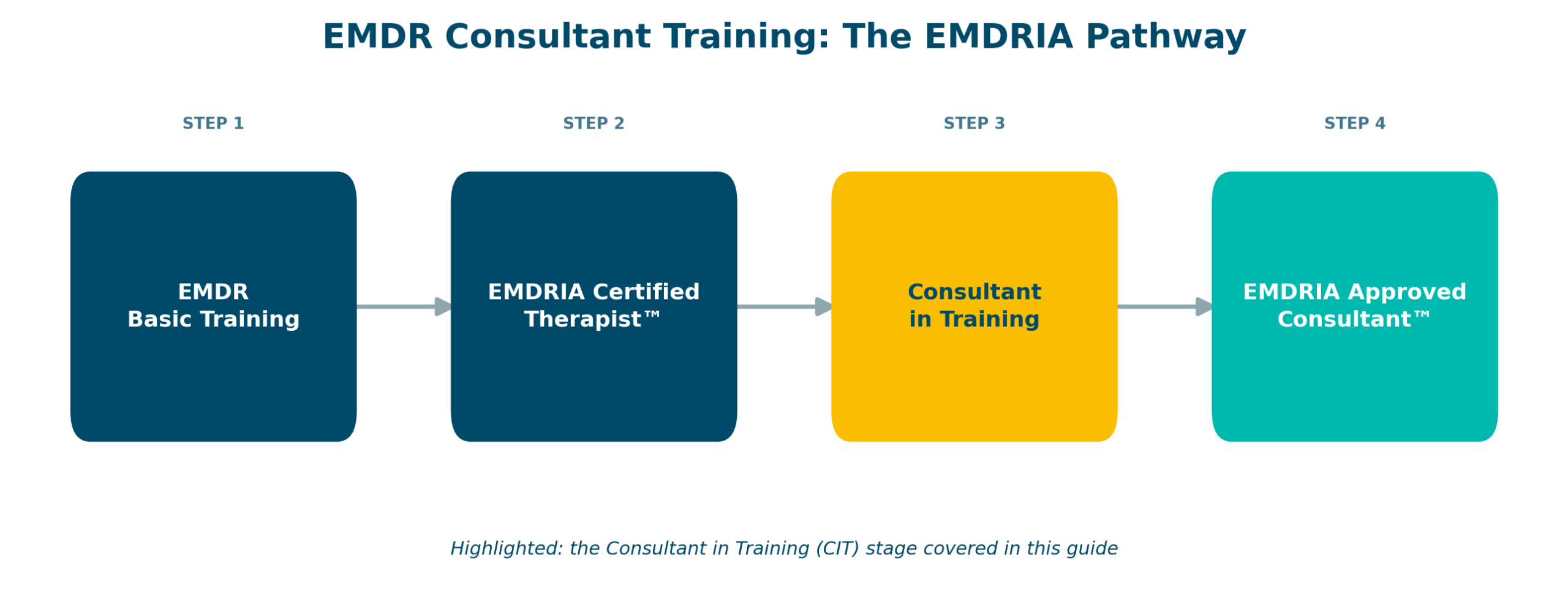
EMDR training—the initial Part 1 and Part 2 weekend intensives or their equivalent and the 10 hours of required consultation—gives you the foundational knowledge and supervised practice to begin using EMDR with clients. It’s where the clinical journey starts. Afterwards, you are considered “EMDR Trained” and can utilize EMDR therapy freely with your clients. Certification, on the other hand, is a formal credentialing process that demonstrates a higher level of competence, clinical experience, and supervised consultation. The EMDR certification process starts after you complete the EMDR basic training and can take 1+ years to complete; therefore, it is not possible to complete the EMDR basic training being EMDR Certified.
EMDRIA (the EMDR International Association) does an excellent job of spelling out this distinction on their website. Their page on training vs. certification explains that training qualifies you to practice EMDR, while certification reflects that you’ve met specific standards around clinical application, consultation, and continuing education. It’s worth reading if you want the official breakdown directly from the source.
In short: training gets you started. Certification signals that you’ve done the work to deepen your competence and hold yourself to a higher professional standard.
What EMDR Certification Actually Means
EMDR certification through EMDRIA is a voluntary credential—meaning it’s not required to practice EMDR. Certification signals to clients, referral sources, and colleagues that you’ve gone beyond the basics. It means you’ve treated a meaningful number of clients using EMDR, received structured consultation to support your growth, and committed to ongoing education in the modality.
For clinicians working in trauma-specialized settings—with veterans, first responders, or other high-need populations—EMDR certification is often a differentiating factor that opens doors. The consultation hours push you to reflect on your work, troubleshoot stuck cases, and deepen your understanding of the adaptive information processing model that underlies EMDR.
EMDR Certification Requirements: High-Level Overview
The following requirements are based on EMDRIA’s certification standards. Always verify current requirements directly with EMDRIA, as standards can be updated.
- EMDR Training: Completion of an EMDRIA-approved basic EMDR training program. This is the starting point—you cannot pursue certification without it.
- Licensure: You must hold an independent mental health license in your state or jurisdiction. Associate-level or supervised licensure typically does not qualify; check EMDRIA’s current guidelines for specifics.
- Clinical Experience with EMDR: EMDRIA requires that clinicians complete a minimum of 50 hours of EMDR therapy conducted with at least 25 different clients in order to meet the clinical experience requirement. In other words, those 50 hours must reflect actual EMDR sessions delivered across a minimum of 25 individual clients—not concentrated with just a few cases. Because standards can change, it’s always important to confirm the most current requirements directly at EMDRIA.org.
- Consultation Hours: You must complete a set number of individual and/or group consultation hours with an EMDRIA-Approved Consultant. Per EMDRIA guidelines, this typically includes at least 20 hours of consultation completed post-training.
- Continuing Education: Completion of additional EMDR-focused continuing education hours beyond basic training. EMDRIA specifies the minimum number of CE hours required—check their current certification application for the exact figure.
- Letters of Recommendation: At least one letter from your EMDRIA-Approved Consultant, and potentially additional professional references.
- Application and Agreement: A completed application submitted to EMDRIA along with documentation of all requirements and adherence to EMDRIA’s code of ethics.
Timeline: How Long Does It Take to Become EMDR Certified?
The honest answer: it depends. Caseload, availability of consultants, access to training opportunities, and personal momentum all factor in.
Sample Roadmap
| Timeframe | Milestone |
|---|---|
| Months 0–1 | Complete basic EMDR training; begin seeing EMDR clients |
| Months 1–3 | Identify and schedule an EMDRIA-Approved Consultant; begin consultation |
| Months 3–9 | Accumulate EMDR client sessions; continue regular consultation; complete CE hours |
| Months 9–12 | Track remaining hours; finalize letters of recommendation |
| Months 12–18 | Submit certification application to EMDRIA |
Hours: Tracking Consultation and Clinical Experience
One of the most common sources of stress in the certification process is documentation. Clinicians often reach the application stage only to realize their records are incomplete or unclear. Setting up a simple tracking system early on saves real headaches later.
What to Track Each Week
- Date and duration of each EMDR session
- Client identifier (use a code or case number, not a name)
- Whether the session involved active EMDR processing (vs. history-taking or preparation phases)
- Consultation dates, format (individual or group), consultant name, and duration
- Any CE credits earned with provider name, date, and topic
Common Mistakes to Avoid
- Counting consultation hours before basic training completion—pre-training consultation does not count
- Confusing EMDR-adjacent sessions (psychoeducation) with full EMDR processing sessions
- Failing to confirm that your consultant is EMDRIA-Approved before beginning consultation
- Waiting until the end to compile documentation rather than tracking as you go
Costs: What EMDR Certification Typically Costs
EMDR certification is an investment—in time, money, and professional energy. Here’s a realistic breakdown.
Consultation Fees
EMDRIA-Approved Consultants set their own rates. Individual consultation typically ranges from $100–$250 per hour, depending on the consultant’s experience, specialty, and region. Group consultation is often less expensive per hour. For 20+ required hours, budget $2,000–$5,000 for consultation alone, depending on your mix of individual and group sessions.
Continuing Education / EMDR Advanced Training
Advanced EMDR trainings—specialty topics like EMDR with children, complex trauma, dissociation, or specific populations—often count toward CE requirements and deepen clinical competency. These range widely, from $150–$600+ per training, depending on length and provider.
Application Fees
EMDRIA charges an application fee for certification. Check EMDRIA.org for current fee schedules, as these can change.
Administrative Time
This is the hidden cost no one talks about. Compiling documentation, writing or requesting letters, and completing paperwork takes time. Budget a few hours and factor that into your planning.
Total Estimated Range: Many clinicians spend $3,000–$7,000 on the full certification process when accounting for consultation, CE, and application fees. Costs vary significantly by region, consultant, and training choices.
Budgeting Tips
- Prioritize group consultation sessions to reduce per-hour costs while still accumulating required hours
- Look for CE trainings that address your clinical interests—this makes the investment feel valuable, not obligatory
- Some employers or agencies will reimburse continuing education costs; ask HR before you assume the answer is no
- Check whether your professional association memberships offer discounted trainings or resources
How EMDR Certification Supports Clinical Growth
The requirements for EMDR certification aren’t arbitrary checkboxes—they’re structured to build real clinical competence. The consultation process, in particular, is where most clinicians report the biggest growth.
Working with an EMDRIA-Approved Consultant means regularly presenting cases, examining your protocol choices, and receiving feedback in real time. This kind of structured reflection improves case conceptualization, helps clinicians stay true to the EMDR protocol (known as fidelity), and leads to better client outcomes. Many clinicians describe their consultation period as transformative—not just for their EMDR work, but for their clinical identity more broadly.
EMDR Advanced Training—whether in specific populations, trauma subtypes, or adjunct approaches—extends this growth further. Pursuing specialized training as part of your certification journey positions you to work more effectively with the clients who need specialized care most.
Common Challenges (and How to Overcome Them)
“I can’t get enough EMDR cases.”
This is especially common for clinicians in generalist settings. Be explicit with referral sources that you’re accepting trauma cases and that you’re pursuing EMDR certification. Update your Psychology Today or other directory profiles to reflect EMDR as a specialty. Consider joining a consultation group where clinicians share strategies for building trauma-focused caseloads.
“I’m not sure which hours actually count.”
When in doubt, ask your consultant before the session—not after. Your EMDRIA-Approved Consultant is one of the best resources for clarifying what counts toward certification requirements. EMDRIA’s office can also clarify specific documentation questions.
“I feel behind after my training.”
A gap between training and active practice is incredibly common, especially when you’re trying to build confidence with a new modality. Give yourself permission to start with clients who are stable and appropriately prepared. Early consultation can help bridge that gap faster than trying to figure it out alone.
Imposter Syndrome and Perfectionism
EMDR is a protocol-driven modality, which can paradoxically trigger perfectionism—clinicians sometimes feel like they’re doing it wrong even when their clients are processing and progressing. This is one reason consultation is built into the certification process. Use those hours to bring your most uncertain cases. That’s exactly what they’re for.
Ready to Take the Next Step?
Becoming EMDR certified takes time and commitment—but it’s one of the most professionally rewarding paths a trauma-focused clinician can take. The timeline is manageable, the costs are plannable, and the clinical growth you’ll experience along the way makes the investment worthwhile.
To recap: plan for 12–30 months depending on your practice context, set up your documentation system from day one, prioritize finding an EMDRIA-Approved Consultant early, and budget realistically for consultation and EMDR Advanced Training costs.
If you’re still deciding whether certification is right for you, check out this post.
If you’re ready to move forward, check out Scaling Up’s EMDR Certification Program—a structured pathway designed to support clinicians through every stage of the certification process, with a particular focus on clinicians serving underserved and specialized populations.