


If you specialize in adolescent therapy, you already have the harder half of this figured out. You know how to read a teenager who’s three sentences from shutting down, how to earn trust, and how to work with a family system without losing the adolescent’s confidence in the process. EMDR therapy for adolescents doesn’t ask you to unlearn any of that. What it adds is a structured, phase-based way of helping a teen’s nervous system finish processing something it got stuck on—layered onto clinical instincts you’re already using every session.
This piece walks through what that addition looks like: how the eight-phase model fits alongside adolescent-specific clinical skill, how preparation and caregiver involvement work within EMDR specifically, where trauma therapy for teens draws on developmental science you likely already apply, and what the research on EMDR therapy for adolescents does and doesn’t yet support.
Why Is EMDR Therapy Effective for Adolescents?
None of the developmental picture below will be new to a clinician who already specializes in teen therapy. What’s worth naming is why it makes EMDR therapy for adolescents a particularly good fit rather than an awkward import from adult practice: the model meets teens where their nervous systems and identities actually are—in flux, highly reactive to social context, and still building the neural architecture that governs emotional regulation and executive function. It doesn’t require sophisticated verbal insight before healing can happen, which matters with a population that often can’t, or won’t, narrate their experiences in detail.
Adolescence is a unique and important developmental period. The prefrontal cortex, responsible for impulse control and emotional modulation, is still under construction well into the mid-twenties, while the limbic system is already running at full adult intensity. That mismatch explains a lot of what looks like inconsistency in teenage behavior.
Trauma layered onto that picture ripples outward fast: emotional regulation suffers first, identity development gets disrupted when a teen organizes their sense of self around what happened to them, peer and family relationships grow fraught, academic performance declines as a dysregulated nervous system loses bandwidth for attention, and behavior gets misread as defiance when it’s really a survival response. This is the territory where EMDR therapy for adolescents can offer something talk-based approaches sometimes can’t reach.
How Does EMDR Need to Be Adapted for Teen Clients?
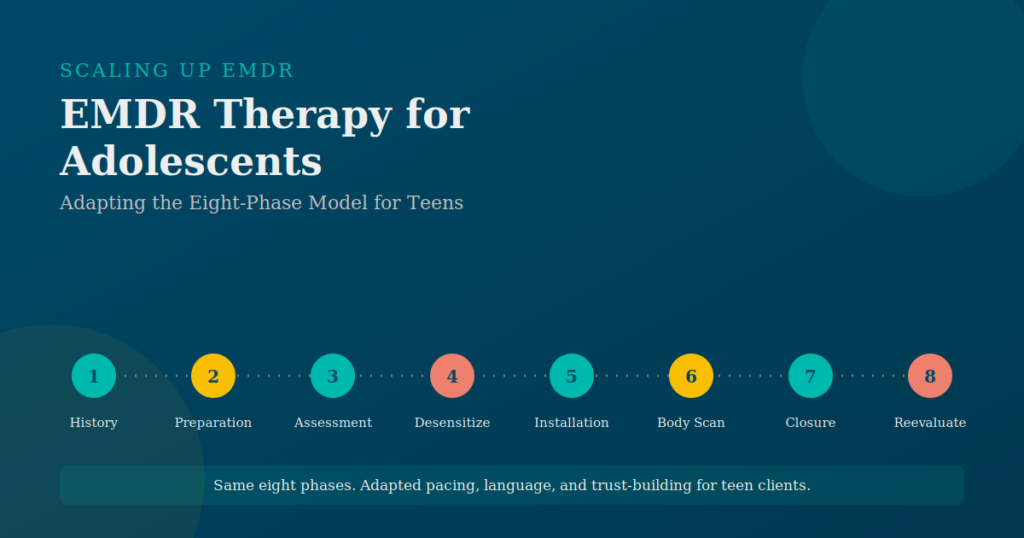
EMDR needs to be adapted for teen clients mainly through pacing, language, and relational stance—not through changes to the eight phases themselves. Adapting EMDR therapy for adolescents means the core model stays intact while the clinician spends more visible effort earning trust and handing control back to the client along the way.
A few adaptations show up consistently:
- Building rapport before trauma processing. Teens sense quickly whether an adult is genuinely curious about them or running through an intake form. Spend real time on interests and daily life before history-taking.
- Adjusting language to match developmental level. Terms like “adaptive information processing” mean little to most fourteen-year-olds. Framing EMDR as helping the brain finish digesting something it got stuck on tends to land better.
- Using shorter or more flexible sessions when appropriate. Some adolescents sustain a full session of reprocessing; others do better with shorter windows and frequent check-ins.
- Respecting adolescent autonomy. Letting a teen choose where to start or which memory to work on first can be the difference between engagement and shutdown.
- Collaborating without becoming overly directive. Adolescents push back hard against feeling managed, even when guidance is well-intentioned.
- Balancing structure with flexibility. Predictability builds safety, but rigid adherence to a session plan when a teen isn’t ready that day tends to backfire.
None of this changes what the model is. History-taking, preparation, assessment, desensitization, installation, body scan, closure, and reevaluation remain the scaffolding of EMDR therapy for adolescents. What shifts is the texture of how a clinician moves through each phase with a client whose developmental stage demands different relational attunement than an adult client would.
Why Is Preparation Especially Important With Adolescents?
Preparation carries more weight in EMDR therapy for adolescents than in most adult treatment, because teens often haven’t yet built a reliable internal sense of safety, and trust with an adult clinician can’t be assumed. Rushing this phase is one of the most common ways things go sideways.
Resourcing deserves real time in EMDR therapy for adolescents. A calm place or a protective figure works best when a teen has located something that feels genuine, even if that’s a fictional character or a pet rather than an adult-style resource. Emotional regulation skills—grounding, breathing, body-based awareness—need to be practiced in session, not just described, particularly for teens with a history of dysregulated behavior.
Establishing safety and building trust go hand in hand here. Many adolescents didn’t choose therapy themselves; a parent or school did. Explaining the EMDR process in language teens actually understand, more than once if needed, counters the disorientation of feeling like something is being done to them. Throughout preparation, helping teens feel they have real choice and control over pacing, topic, and when to pause builds the agency that trauma so often strips away in the first place.
What Role Do Parents or Caregivers Play?
Parents and caregivers play a supporting but carefully bounded role: essential for consent and reinforcing regulation skills at home, while the adolescent still needs enough privacy to process honestly. Getting this balance wrong in either direction tends to undermine treatment.
Confidentiality needs addressing directly and early. Teens disclose more honestly when they know what will and won’t be shared. Most clinicians communicate general themes and safety concerns to caregivers while keeping specific session content private unless safety requires otherwise.
Parent or caregiver involvement outside of session usually looks like psychoeducation: helping caregivers understand what a course of treatment might look like and what reactions to expect as processing unfolds, including that things can look rockier before they look better. Caregivers who understand this ahead of time are far less likely to pull a teen out of treatment prematurely. Supporting treatment outside of sessions might mean reinforcing a resource at home or simply not interrogating a teen after each appointment, and managing expectations up front prevents disappointment from derailing engagement later. When therapist, teen, and caregiver collaborate well, EMDR therapy for adolescents tends to move more smoothly without compromising the adolescent’s privacy.
How Does Trauma Therapy for Teens Differ From Adult Treatment?
Trauma therapy for teens differs from adult treatment mainly because adolescents are navigating active, ongoing developmental processes—brain maturation, identity formation, peer relationships—that adults have largely already worked through. As a clinician who works primarily with teens, you’re used to holding this distinction in general practice; it’s worth naming explicitly here because it’s also the throughline for why EMDR gets adapted the way it does. The trauma isn’t landing on a finished structure; it’s landing in the middle of construction.
Brain development is the clearest example. An adult’s prefrontal cortex is mostly mature, so trauma work doesn’t have to contend with an organ still building its own regulatory capacity the way EMDR therapy for adolescents does. Identity formation adds another layer entirely unique to this age group: trauma can get woven into an emerging sense of self in ways that are harder to untangle later.
Peer relationships carry outsized weight in adolescence, and school stress compounds this since academic pressure and social dynamics are inseparable for most teenagers. Family dynamics play out differently too—adolescents are still living inside the family system, sometimes dependent on caregivers who are part of the trauma history itself. Social media adds a layer that didn’t exist for prior generations: constant comparison, exposure to triggering content, and a searchable record of painful events. Trauma therapy for teens has to account for all of this unfolding in real time, not superimposed onto an already-settled life structure.
What Challenges Commonly Arise During EMDR Therapy For Adolescents?
The challenges that come up most in adolescent EMDR are resistance, avoidance, limited insight, emotional dysregulation, shame, and difficulty putting experiences into words—and most respond better to patience than to pushing harder.
Resistance during EMDR therapy for adolescents often isn’t resistance to the method; it’s resistance to feeling exposed or controlled. Naming that directly, and handing back control over pacing, does more than reassurance. Avoidance shows up as canceled sessions or going quiet during processing; slowing down and shoring up resourcing helps more than confronting it head-on.
Limited insight is developmentally expected, not a deficiency—many adolescents don’t yet have the reflective capacity to articulate why something bothers them. Somatic and image-based approaches work well here, since they don’t require intellectual explanation. Emotional dysregulation calls for pausing reprocessing to use the regulation toolkit built in preparation, rather than pushing through a target.
Shame is a frequent undercurrent, particularly around abuse or bullying. Normalizing it as a common trauma response, rather than an obstacle, tends to loosen its grip. And when verbalizing experiences is hard, drawing, writing, or choosing an image that captures a feeling often works better than insisting on words. Across all of these, engagement improves when teens feel like collaborators rather than patients being managed.
What Does the Research Say About EMDR Therapy for Adolescents?
The research on EMDR therapy for adolescents is continually expanding. Many findings are promising, but as always, conclusions should stay measured rather than definitive.
A 2024 case series published in Healthcare followed twenty-two adolescents, aged twelve to seventeen, who all met ICD-11 criteria for complex PTSD following childhood abuse. The study investigated the efficacy of eye movement desensitization and reprocessing on complex post-traumatic symptoms and associated psychiatric disorders in adolescents with a history of abuse. After three months of treatment, researchers observed a significant decrease in average PTSD symptom scores, along with improvements in depression, anxiety, emotional regulation, insomnia, and substance use measures. As a case series without a comparison group, this can’t rule out the role of time or general clinical support, but it adds to evidence that EMDR therapy for adolescents can be tolerated and clinically meaningful even for complex trauma histories. (Read the study)
A second study, published online in Clinical Child Psychology and Psychiatry in early 2026, examined EMDR’s effectiveness with social anxiety disorder in twenty-six adolescents aged twelve to sixteen. The study aimed to examine the effectiveness of Eye Movement Desensitization Therapy in Social Anxiety Disorder, tracking outcomes with standardized anxiety measures across a twelve-week follow-up. Like the case series above, this was a follow-up study rather than a randomized controlled trial, so it points toward feasibility and preliminary trends more than firmly established efficacy. (Read the study)
Taken together, these studies suggest EMDR therapy for adolescents is a reasonable, well-tolerated option across complex trauma and anxiety presentations, while also underscoring that larger, controlled trials are still needed.
How Can School-Based Clinicians Use EMDR Therapy For Adolescents?
School-based clinicians can bring the principles behind EMDR therapy for adolescents into educational settings even when a full course of reprocessing isn’t feasible within a school day. Stabilization skills, resourcing, and brief targeted work on a discrete incident often fit within the shorter, less predictable windows school schedules allow.
Sessions might run twenty to forty minutes instead of a full hour, private space can be scarce, and long-term continuity isn’t guaranteed. Group protocols become valuable after a shared crisis event affecting multiple students. For more on consent and building administrator buy-in, check out our Scaling Up Your Impact Podcast episode Using EMDR in K–12 School Settings.
What Skills Should Therapists Develop Before Adding EMDR to Adolescent Work?
Therapists who already specialize in adolescents typically bring the developmental knowledge, trauma-informed instincts, and parent collaboration skills this work requires. What’s genuinely new when adding EMDR therapy for adolescents to that foundation is the model-specific piece: the eight-phase structure, working memory taxation via bilateral stimulation, and a case conceptualization framework organized around targeted memories rather than general symptom reduction and coping strategies. Formal training through a recognized program is the starting point, since the model has its own theoretical framework and clinical application that talk-therapy training doesn’t cover.
Case conceptualization within EMDR asks clinicians to hold developmental context alongside a target-based trauma history—specific memories, negative beliefs, and body sensations—rather than treating trauma as a diffuse background concern. That’s a different organizing lens than most adolescent-specialized training provides, even for clinicians who already do excellent trauma work. Cultural humility still matters as much as it does anywhere in adolescent practice, but it surfaces differently here, particularly around how memory networks and belief systems get explored. Ongoing consultation with EMDR-trained clinicians experienced in child and adolescent work, plus continued education specific to this population, helps close the remaining gap.
What Are the Most Important Takeaways for Therapists?
If there’s one thread running through EMDR therapy for adolescents, it’s that teens need patience before they need technique. Developmentally appropriate interventions, genuine collaboration, flexibility in pacing, and consistency in the relationship matter more than any single protocol modification. Building trust before trauma processing begins isn’t a delay tactic—it’s the foundation the rest of the work depends on.
EMDR therapy for adolescents, done well, respects both the integrity of the eight-phase model and the developmental reality of the client sitting across from you. That combination, more than any single technique, is what makes the work effective.
If you want to improve therapeutic outcomes with your adolescent clients, strengthen your trauma treatment skills through Scaling Up’s EMDR Basic Training. Our curriculum includes a dedicated section on EMDR with kids and teens, so you’ll be able to bring EMDR into your work with adolescent clients right after training—no separate specialty course required to get started.
Already EMDR trained and want to go deeper with this population? Our EMDR with Children and Adolescents mini-course covers phase-by-phase protocol adaptations, target sequencing by trauma type, and play-based and attachment-informed techniques across the full youth age range.
