

If you’ve ever finished a great intake and thought, “I wish I’d known about this client sooner,” you already understand why referrals matter. Growing an EMDR practice rarely happens through a single marketing tactic or a lucky moment of visibility. More often, it happens one relationship at a time, with the colleagues and partners who see clients before you ever do.
This guide covers how to build a referral network as an EMDR therapist that holds up over time: who belongs in it, how to earn trust within it, and what to avoid. None of this promises a full caseload by next month. It’s a grounded approach to how to get referrals as a therapist, one you can start this week, and one of the more sustainable paths toward growing an EMDR practice long term.
Why Does a Strong Referral Network Matter for EMDR Therapists?
A strong referral network matters because it’s one of the few sources of new clients that doesn’t depend on ad spend, algorithm changes, or luck. When a psychiatrist, pediatrician, or fellow therapist refers someone to you, that referral arrives already carrying a measure of trust you didn’t have to build from scratch.
Referrals also tend to be a better fit clinically. A colleague who understands your specialty is more likely to send someone whose needs match your training, whether that’s complex trauma, first responders, or dissociative presentations. That alignment matters more for growing an EMDR practice than sheer volume of leads ever will.
Trust is the real currency here. Professionals refer to people they believe will treat their patients competently and communicate clearly when appropriate. You can’t manufacture that with a clever tagline; it’s earned through consistent, ethical work, which is why referral relationships tend to compound rather than spike. One good experience with you as a referral partner can lead to years of steady referrals, long after any paid ad campaign would have stopped paying for itself.
Who Should Be in Your Referral Network?
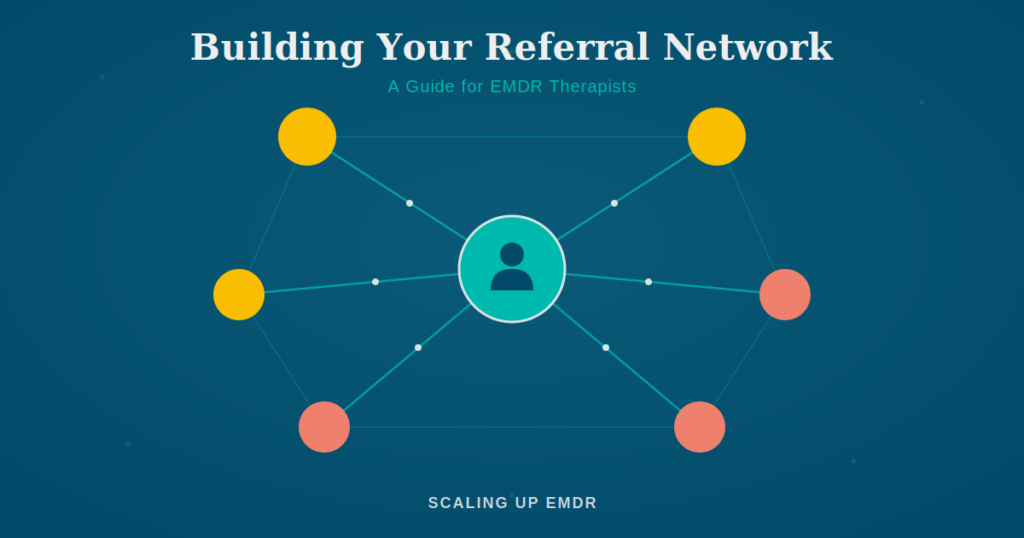
Your referral network should include a mix of professionals and organizations who regularly encounter people who could benefit from EMDR, not just other therapists. The wider that mix is, the less your practice depends on any single source, and the more resilient your approach to growing an EMDR practice becomes.
Consider building relationships with:
- Individual therapists who don’t offer EMDR or are at capacity and need somewhere trustworthy to send overflow clients
- Psychiatrists who see patients struggling with similar diagnoses like anxiety, depression, or PTSD
- Primary care providers, often the first to hear about trauma symptoms disguised as chronic pain or insomnia
- Pediatricians, particularly those treating children with anxiety, school avoidance, or medical trauma
- School counselors, who see kids carrying stress beyond what a school setting can address
- Group practices looking for specialized providers when a client’s needs fall outside their scope
- Couples therapists, who often encounter individual trauma histories needing dedicated EMDR work
- Substance use professionals, given how often trauma and substance use intersect
- Community organizations, including shelters, immigrant support services, and faith communities
- Employee Assistance Programs (EAPs), which maintain lists of trusted outside providers for employees needing care
A diverse referral network tends to produce steadier referral flow than relying on one or two sources. If your caseload is built almost entirely on referrals from a single psychiatrist’s office, a change in that relationship can leave a real gap. Spreading your relationships across several categories protects against that kind of disruption.
How Do You Build a Referral Network as a Therapist?
The most reliable way to get referrals as a therapist is to build genuine professional relationships and then show up as someone dependable, over and over, until you’re the person a colleague thinks of without hesitation. There’s no shortcut that replaces this, though a few habits speed it along.
Start with relationships you already have. Former colleagues, supervisors, and classmates from your EMDR training cohort are warmer starting points than a cold outreach list. A short, genuine note asking to catch up, rather than a pitch, tends to open more doors.
From there, a few habits make a real difference:
- Follow up consistently. A single coffee meeting rarely creates a lasting referral relationship. Checking in every few months keeps you top of mind.
- Be reliable and responsive. If a colleague sends someone your way and you take three weeks to respond, that’s the last referral you’ll get from them.
- Communicate your specialty clearly. Vague descriptions like “I work with trauma” don’t stick. “I specialize in EMDR for first responders” gives a referral source something specific to recall.
- Make it easy for colleagues to refer to you. A simple referral form and a clear intake process remove friction. The easier the handoff, the more likely it happens.
- Maintain professional visibility. Attend local trainings, join consultation groups, and stay active in your professional community.
- Practice reciprocity. Referral relationships run both directions. If a colleague sends you clients, look for genuine opportunities to send referrals back their way when it’s a good clinical fit. A network that only flows toward you tends to dry up.
- Host local or virtual gatherings. An educational lunch-and-learn on EMDR basics for other clinicians, or a more social meetup for colleagues in your area, gives people a low-pressure way to get to know you as both a clinician and a person. Either format works; what matters is showing up regularly enough that you become a familiar, trusted presence.
None of this needs to feel transactional. The therapists who build the strongest referral networks approach it as relationship-building first and business development second, which is also what makes the relationships last.
What Makes Other Professionals Comfortable Referring to Your Network?
Other professionals feel comfortable referring to you when they trust your clinical competence, your communication style, and your consistency. Referral relationships rest on the referring provider’s confidence that their patient will be in capable, ethical hands.
A few things build that confidence:
- Clinical competence. Ongoing consultation, continuing education, and staying current with protocol adaptations signal that you take your craft seriously.
- Professional communication. How you write emails and handle scheduling hiccups shapes how a colleague perceives you.
- Timely updates when appropriate. With proper releases in place, a brief note confirming a client attended intake shows you treat the referral as a shared responsibility.
- Clear referral processes. Providers appreciate knowing exactly what happens after they refer someone, including wait times and how to reach you.
- Ethical collaboration. Respecting scope of practice and communicating honestly about fit reinforces that you’re a trustworthy partner.
- Consistency and dependability. Professionals refer to people who show up the same way every time. Predictability builds trust faster than any single credential.
How Can You Market Yourself Without Feeling Salesy?
You can market yourself without feeling salesy by focusing on education and relationship-building rather than direct self-promotion. When your visible presence in the community centers on helping people understand trauma and EMDR, marketing starts to feel like an extension of clinical work instead of something separate from it.
Some approaches that tend to feel more natural for clinicians:
- Educational content, like blog posts or handouts that explain how EMDR works and who it helps
- Speaking opportunities, whether a podcast guest spot, a clinician webinar, or a talk for a local support group
- Community presentations at schools, healthcare offices, or nonprofits, which build visibility and goodwill
- Networking events, including local clinician meetups or EMDRIA regional gatherings
- Social media used professionally, focused on useful information rather than personal branding
- Website optimization, so a referral source or client can quickly understand your specialty and reach you
- Referral packets, a short document that gives referral partners what they need to send someone your way
- Email newsletters, sent to referral partners with occasional updates or reminders that you’re still taking referrals
If you want a deeper walkthrough of building this kind of visibility without it feeling forced, Marketing Yourself as an EMDR Therapist covers positioning, pricing, and relationship-based strategy in more depth.
What Mistakes Weaken Your Referral Network?
The most common mistake is waiting passively for referrals instead of actively building and maintaining the relationships that produce them. A packed caseload two years ago doesn’t guarantee one now, especially if the relationships behind it haven’t been tended.
Other patterns worth watching for:
- Trying to appeal to everyone instead of developing a clear specialty. A generalist message is easy to forget; a specific one sticks.
- Letting your website go stale. An outdated site, one that still describes services you no longer offer, undermines trust.
- Inconsistent communication. Referral partners notice when you go quiet for months after an initial period of frequent contact.
- Not nurturing existing relationships. It’s easy to chase new referral sources while neglecting the ones already sending you clients.
- Forgetting to thank referral partners. A brief note of appreciation, within the bounds of confidentiality, reinforces that the relationship matters.
How Do Your Fees Influence Referral Decisions?
Your fees influence referral decisions because referring providers want to set realistic expectations for the people they send your way, and unclear or inconsistent pricing makes that harder for everyone involved. Transparency about what you charge, and why, tends to build more trust than pricing that feels like a mystery until the first invoice.
A few principles help here:
- Transparency. Make your fee structure easy to find and understand, both for clients and referring professionals.
- Communicating value. Referral partners benefit from understanding what your rate reflects: session length, training, or the intensity of certain EMDR formats.
- Insurance versus private pay. Being upfront about whether you accept insurance or operate private-pay-only helps referral sources set accurate expectations.
- Accessibility options. A limited number of sliding-scale slots can make you a more comfortable referral for providers serving lower-income populations.
- Aligning fees with experience and specialty. Referral partners trust pricing that makes sense given your training and niche.
For a deeper look at how to think through pricing as both a clinical and business decision, Setting Private Pay Rates as an EMDR Trained Therapist walks through the variables that shape a sustainable rate.
Does EMDRIA Membership Help Build Your Referral Network?
EMDRIA membership can support your referral network by adding professional credibility and connecting you to a wider community of EMDR-trained clinicians, though it isn’t a direct pipeline of new clients on its own. Full EMDRIA membership includes a profile listing in the Find an EMDR Therapist directory, which is built to perform well in search results and can help clients and colleagues find you online.
Beyond the directory listing, membership offers a few practical advantages:
- Professional credibility. Maintaining active membership signals ongoing commitment to EMDRIA’s practice standards.
- Networking opportunities. Regional meetings and the EMDRIA conference create natural touchpoints with other EMDR-trained clinicians.
- Directory listings. A searchable, well-optimized directory profile gives you visibility beyond your own marketing efforts.
- Continuing education. Access to EMDRIA’s education calendar helps you stay current, which supports the clinical competence that underlies referral trust.
- Community involvement. Participating in EMDRIA’s broader community keeps you connected to the profession in ways that occasionally translate into referral relationships.
Membership is a supportive piece of the picture, not a referral engine by itself. The relationships you build still do most of the work.
How Long Does It Take to Build a Strong Referral Network?
Building a strong referral network typically takes months to years, not days or weeks, because it depends on trust that develops through repeated, reliable interactions rather than a single introduction. Anyone promising a fast, guaranteed pipeline of referrals is overselling what growing an EMDR practice through relationships actually requires.
Consistency matters more than intensity. A therapist who reaches out to one or two new contacts a month, follows up reliably, and stays visible in their professional community will typically build a more durable network than one who sends fifty introductory emails in a single week and then goes quiet. Small, ongoing efforts, sustained over time, tend to produce better long-term results than occasional bursts of networking energy followed by long gaps.
This is, in many ways, good news. You don’t need a dramatic launch strategy. You need a habit you can actually sustain alongside a full clinical caseload.
What Should You Focus on First When Building a Referral Network?
If you’re starting from scratch or want to strengthen an existing network, a few practical steps can get momentum going this week:
- Reach out to former colleagues. Send a short, genuine message to people you’ve worked with before, letting them know what you’re doing now and what you specialize in.
- Update your referral materials. Make sure any referral packet, one-pager, or website page accurately reflects your current specialty, fees, and availability.
- Schedule coffee meetings. Pick two or three professionals you’d like to know better and invite them for a low-pressure conversation, not a pitch.
- Improve your website. Confirm that a visitor, whether a client or a referring provider, can quickly understand what you offer and how to reach you.
- Identify your ideal referral partners. Get specific about which professionals in your area see the clients you’re best suited to help, and start there rather than trying to contact everyone at once.
None of these steps require a dramatic time investment, but doing even a couple of them consistently will move you further than waiting for referrals to arrive on their own.
Ready to Build a Referral Network for a Sustainable EMDR Practice?
Growing an EMDR practice through referrals is steady work, not a quick win, and that’s precisely why it holds up over time. If you’d like a step-by-step system for attracting more ideal clients and building a thriving EMDR practice, explore Scaling Up’s Marketing EMDR for Practice Growth course. You’ll learn proven marketing strategies that help therapists grow ethically, confidently, and sustainably.