


When you finish your EMDR basic training, the path forward toward EMDR training and certification can feel a little murky. You know consultation is required for certification, but there are real questions about what format makes sense for you. Group consultation? Individual? Some combination of both? And does it actually matter, or is any consultation just consultation?
These are legitimate questions, and they come up often. The honest answer is that the format does matter — not because one is objectively better, but because different therapists learn differently. Some people do their best thinking in conversation with peers. Others need space to go deep on a single case without feeling rushed. A lot of clinicians benefit from both at different points in their development.
This article is an attempt to help you think through which option fits your learning style, your caseload, and your certification goals. There is no single right answer here, but there are some useful questions to sit with.
Why Consultation Matters in EMDR Training and Certification
Consultation occupies a central place in EMDR training and certification — and for good reason. Learning the protocol in a training setting is genuinely different from applying it with a real client who has a complicated history, limited window of tolerance, or multiple presenting concerns. That gap between training and practice is where consultation lives.
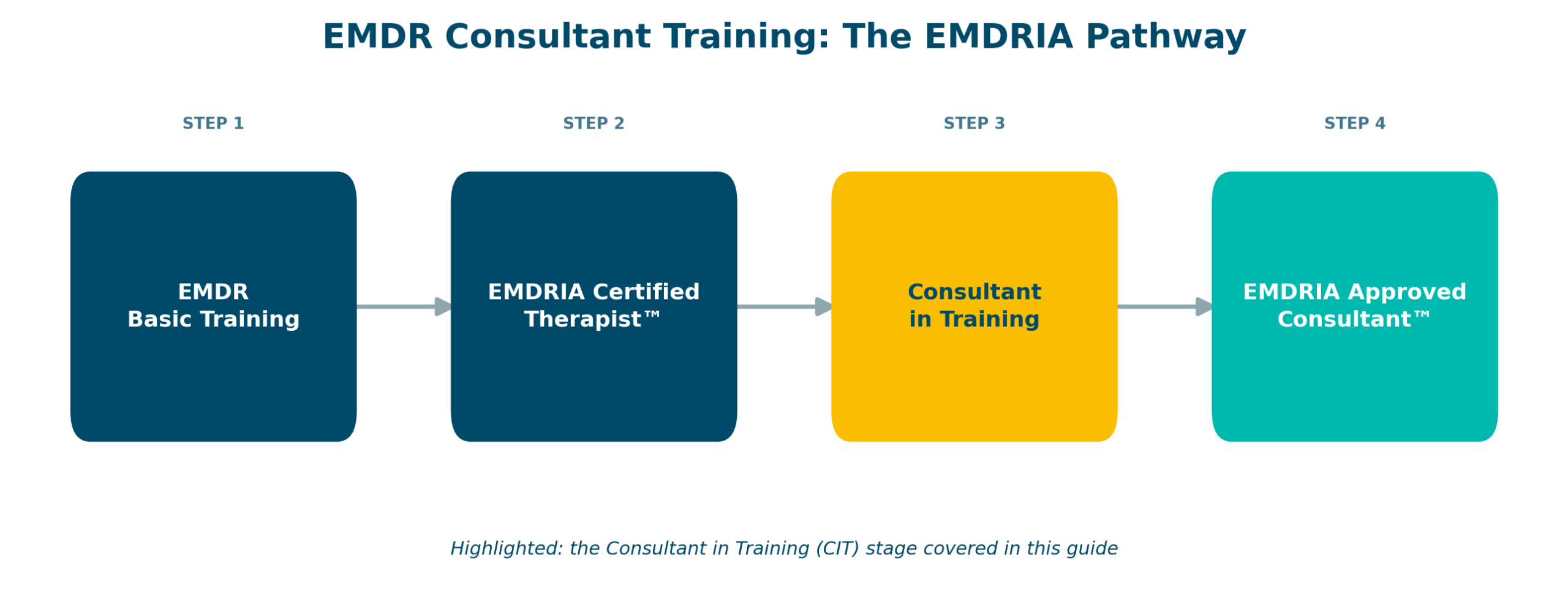
EMDRIA (the EMDR International Association) requires a specific number of consultation hours as part of the certification process. These hours must be completed with an EMDRIA Approved Consultant, and they are meant to serve a real clinical purpose: helping you develop case conceptualization skills, work through challenges in your use of the protocol, and refine your ability to make sound clinical judgments within EMDR.
Consultation also functions as a kind of ethical anchor. When you are working with trauma, there are moments of clinical complexity that deserve another set of eyes. Having a consultant you trust — someone who can help you think through whether a client is ready to process, whether a protocol modification makes sense, or whether you are missing something important — is part of responsible practice.
The format of that consultation shapes the experience considerably. It affects how much time you have to discuss your cases, the kind of feedback you receive, and whether the process feels supportive or stressful.
What Are EMDR Consultation Groups?
EMDR consultation groups bring together a small number of EMDR-trained therapists — typically anywhere from three to eight clinicians — who meet regularly with an Approved Consultant to discuss cases, review protocol use, and work through clinical questions together.
The structure varies depending on the consultant and the group. Some groups follow a set format where each participant brings a case and receives feedback within an allotted time. Others are more fluid, focusing on the most pressing clinical questions in the room. Many include some didactic content alongside case discussion.
EMDR consultation groups have become a popular and practical option for therapists working toward certification. They are often more affordable than individual consultation, and many clinicians find that learning alongside peers adds something valuable that one-on-one formats simply cannot replicate.
Benefits of Group Consultation
Learning from peers
One of the most underrated aspects of group consultation is what you learn from other clinicians. Hearing how a colleague handled a complicated dissociative moment, or how they approached a client who was stuck in preparation for months, can be genuinely illuminating. You are not just learning from the consultant — you are learning from everyone in the room.
Exposure to different cases and approaches
In individual consultation, you only ever bring your own cases. In a group, you are exposed to a much wider range of presentations, populations, and clinical decisions. Over time, this builds a richer mental library of how EMDR actually works across different clients and contexts.
Reduced isolation
Trauma work can be isolating. Many therapists carry their cases quietly, without much opportunity to talk openly about the weight of what they are holding. Consultation groups create a space to do that. The relationships that develop in ongoing groups often provide real support, not just professional development.
Cost effectiveness
Group consultation is generally more affordable than individual consultation because the consultant’s time is shared across participants. For therapists who are early in their careers or working in lower-paying settings, this can make a meaningful difference in whether consultation feels financially sustainable.
Community and connection
Some of the most lasting professional relationships in this field start in consultation groups. Beyond the clinical learning, there is something sustaining about being in a community of people who are doing similar work and taking it seriously.
Benefits of Individual Consultation
Personalized feedback
In individual consultation, every minute of the session is focused on you — your cases, your questions, your development as an EMDR clinician. The consultant can track your progress over time, notice patterns in your clinical work, and offer feedback that is specifically tailored to what you need.
Greater depth on difficult cases
When a case is genuinely complex, a group setting can feel constrictive. There may not be enough time to explore the full picture, and the discussion may stay fairly surface-level. Individual consultation allows you to go deep — to walk through the history, the treatment trajectory, the specific moments of difficulty, and the clinical reasoning without having to watch the clock.
Tailored pacing
Everyone comes to EMDR certification from a different starting point. Some therapists enter with years of trauma-focused experience. Others are newer to the field and are building foundational confidence. Individual consultation allows the pace and focus to match where you actually are, rather than where the group happens to be.
Support for complex presentations
Clinicians working with complex trauma, dissociation, or other challenging presentations often find that individual consultation provides the depth of support those cases require. There is space to think carefully about protocol modification, pacing, safety planning, and the therapeutic relationship in ways that group formats cannot always accommodate.
Potential Challenges of Each Format
Both formats come with tradeoffs, and it is worth naming them honestly.
In group consultation, time is shared. If the group is larger or the discussion runs long on one case, you may get limited airtime for your own. Some clinicians also find it harder to be open about their uncertainty or mistakes in front of peers, particularly early in the certification process when confidence is still developing. Scheduling can also be more rigid in groups, since everyone needs to agree on a time.
Individual consultation carries a higher cost per session, which is a real barrier for some therapists. It can also, paradoxically, feel somewhat isolated. Without the peer dimension, you may miss out on the sense of community and the variety of perspectives that a group provides. Some clinicians find that working exclusively in individual consultation means they develop fewer connections within the broader EMDR community.
Neither format is without limitation. The question is which tradeoffs you can work with, and which ones create barriers to your learning or your ability to complete the certification process.
How to Decide What’s Right for You
A few questions worth sitting with:
- How do you learn best? Some people absorb material more readily in conversation with peers. Others need focused, individualized attention. Neither preference is wrong, but knowing which describes you is genuinely useful.
- Where is your confidence right now? If you are feeling uncertain about your case conceptualization or your use of the protocol, individual consultation may offer more targeted support. If you feel relatively grounded and are looking to broaden your perspective, a group may be the right fit.
- What does your caseload look like? If you are primarily working with straightforward presentations, group consultation may be fully sufficient. If your caseload is weighted toward complex trauma, dissociation, or other challenging presentations, you may benefit from the depth of individual consultation.
- What are the financial realities? Be honest with yourself about what you can sustain. Certification is a process that takes time, and you need a consultation arrangement that is financially workable over the long haul.
- How much do you need connection and community? For therapists who feel isolated in their practice, group consultation provides something that goes beyond clinical learning. If that resonates, it is worth factoring in.
Many Therapists Benefit From Both
It is worth saying clearly: group and individual consultation are not mutually exclusive. Many therapists working toward certification use both, often in different proportions at different stages of their development.
A common approach is to begin with group consultation for the community, the exposure to varied cases, and the lower cost, while also scheduling periodic individual consultation when a particularly complex case arises or when you want focused feedback on a specific area of your practice.
Some clinicians start with individual consultation when they are newer and less confident, then transition primarily to group consultation as they develop more competence and are looking for peer connection rather than intensive support.
There is no formula here. What matters is that you are getting the kind of support that is actually useful to your development, and that your consultation hours are building genuine clinical competence rather than just accumulating on a checklist.
The Role of Consultation in EMDR Advanced Training
For many therapists, consultation does not end when certification is complete. It continues as an ongoing part of professional development, particularly for those who are deepening their work with complex or specialized populations.
EMDR advanced training often incorporates consultation as a structural component, not just an optional add-on. When clinicians are learning new protocols, working with more challenging presentations, or refining skills in areas like complex trauma or dissociation, having a consultant who knows the territory makes a concrete difference.
If you are thinking beyond basic knowledge and are interested in developing more advanced clinical skills, the EMDR Certification Program at Scaling Up offers a structured path that includes consultation as a central feature of the training process, not a box to check after the fact.
Consultation at the advanced level also looks somewhat different. The focus shifts from learning the basic protocol to refining judgment, managing clinical complexity, and developing flexibility in how you apply what you know. The questions get harder, and having a consultant who can meet you at that level matters.
Additional Resources
EMDRIA provides guidance on the types of consultation available to EMDR therapists at various stages of training and certification. Their resource on types of consultation is a useful reference for understanding the differences between consultation formats and how they apply to the certification process. If you have questions about what counts toward your hours or how to find an Approved Consultant, their website is a good starting point.
Conclusion
There is no universally correct answer to the group versus individual consultation question. The right format is the one that supports your learning, fits your practice, and helps you develop into a confident, competent EMDR clinician.
Some therapists thrive in group consultation from the beginning. Others need the individualized attention of one-on-one work before they are ready to learn from peers. Many find that moving between formats depending on what they need at a given stage is the most useful approach of all — and the most effective way to complete EMDR training and certification with confidence.
What matters most is that you are getting genuine clinical support — the kind that actually helps you think more clearly about your cases, use the protocol more skillfully, and feel less alone in the work. Consultation is not just a certification requirement. At its best, it is one of the most valuable parts of the whole process.
Ready to Take the Next Step?
If you are working toward EMDR certification and want a program that integrates consultation as a core part of the learning experience, explore the EMDR Certification Program at Scaling Up EMDR. You can learn about the program structure, upcoming cohorts, and how consultation is woven into the certification path at scalingupemdr.com/emdr-certification-program.